Inverter AC vs Non-Inverter AC: Which Is Better for Indian Homes in 2025?
A practical, unbiased comparison of inverter and non-inverter ACs energy savings, maintenance costs, and which suits your usage pattern.
Introduction
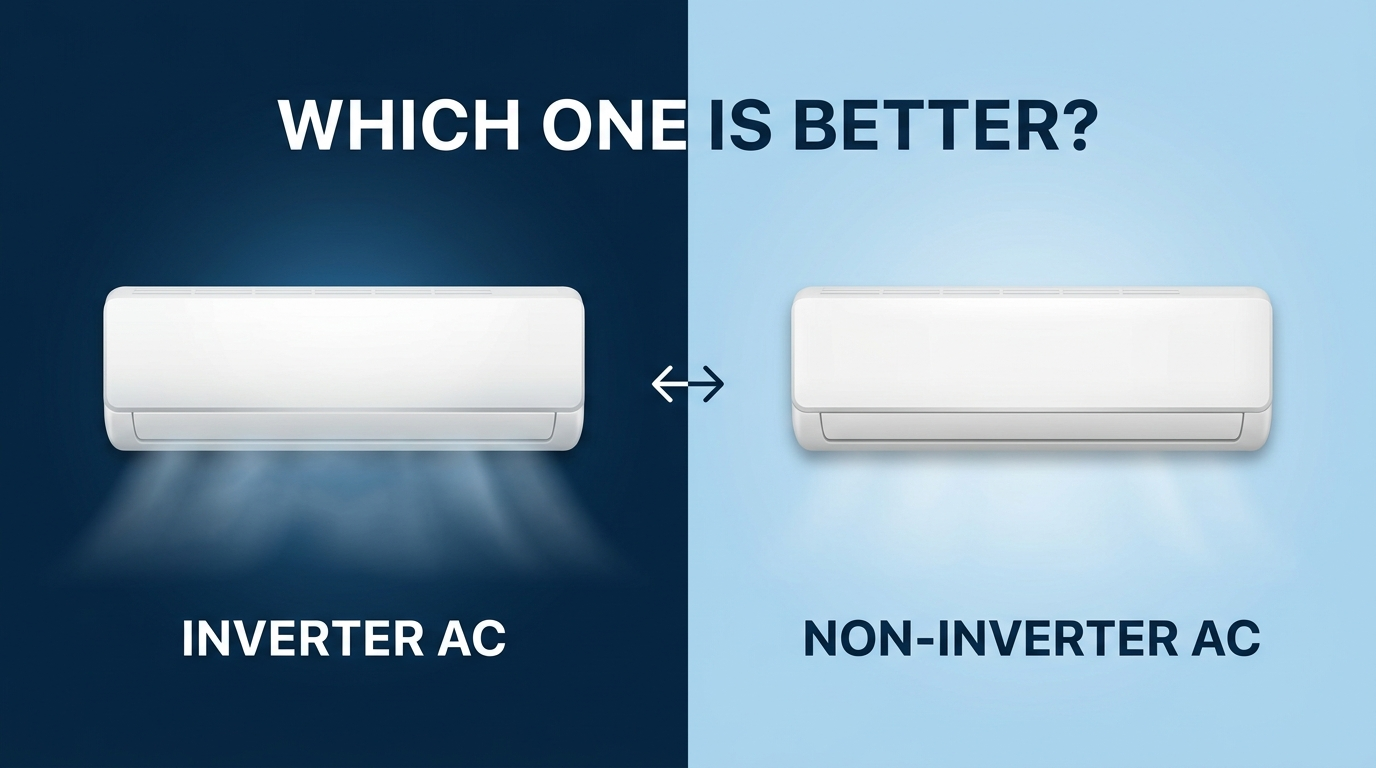
Walk into any electronics showroom in India and you will encounter the inverter vs. non-inverter AC debate almost immediately. Salespeople will push inverter models for their energy efficiency; budget-conscious buyers wonder if the premium is worth it. Both sides have valid points the 'right' choice depends entirely on your usage pattern, room characteristics, and budget.
This guide cuts through the marketing and gives you an honest, practical comparison to make an informed decision.
How They Work: The Core Difference
Non-Inverter (Fixed-Speed) AC
A non-inverter AC's compressor has only two states: fully on or fully off. When the room temperature is above the set point, the compressor runs at full power. When it reaches the set temperature, the compressor switches off completely. This on-off cycle repeats throughout operation creating the temperature fluctuations most users associate with older ACs.
Inverter AC
An inverter AC's compressor operates at variable speeds running faster when the room is hot and gradually slowing down as it approaches the set temperature. It never switches completely off during operation; instead, it settles into a slow 'maintenance' mode, holding the temperature steady with minimal power consumption.
Energy Efficiency: The Numbers
The energy saving advantage of inverter ACs is real and significant:
• A 5-star inverter AC uses approximately 30–50% less electricity than a 3-star non-inverter AC of the same capacity, in typical Indian usage conditions (8+ hours daily)
• At Indian electricity rates (₹6–₹10 per unit), an inverter AC can save ₹3,000–₹7,000 per year in electricity costs for a 1.5-ton unit
• The inverter premium at purchase (₹8,000–₹15,000 over a comparable non-inverter) typically pays back within 2–4 years
Temperature Consistency
Non-inverter ACs create noticeable temperature swings the room overshoots to 2–3°C below the set temperature before the compressor cuts out, then warms up before it kicks in again. Inverter ACs maintain temperature within 0.5–1°C of the set point continuously. For most users, this is a meaningful comfort improvement.
Maintenance and Repair Comparison
Non-Inverter AC
• Simpler electronics cheaper PCB repairs if needed
• Standard compressor widely available, less expensive to replace
• Higher frequency compressor cycling means more wear on motor contactors and capacitors
• Service cost: 10–20% less per visit due to simpler diagnostic requirements
Inverter AC
• Variable-speed inverter PCB is more complex and expensive to replace: ₹4,000–₹10,000 vs. ₹2,000–₹5,000 for standard PCB
• Inverter compressors are more durable due to reduced cycling stress typically last 2–3 years longer
• Requires a technician with inverter AC diagnostic tools and training
• Error code diagnostics are more informative easier to identify specific faults
Which Is Better for Your Situation?
Choose a Non-Inverter AC If:
• Usage is less than 4 hours daily the energy savings don't justify the premium
• Budget is tight and upfront cost is the primary constraint
• The AC is for a holiday home or infrequently used room
Choose an Inverter AC If:
• AC will be used 6+ hours daily energy savings are substantial
• You plan to keep the AC for 8–12 years the long-term value is compelling
• Temperature consistency and quiet operation are priorities
• Electricity bills are a meaningful household expense
The BEE Star Rating System How to Read It
India's Bureau of Energy Efficiency (BEE) star rating goes from 1 star (least efficient) to 5 stars (most efficient). For inverter ACs, the ISEER (Indian Seasonal Energy Efficiency Ratio) rating is the relevant metric higher is better. A 5-star inverter AC has an ISEER of 5.0 or above. Always check the current year's star rating the BEE revises the criteria periodically, so a 5-star rating from 2020 may only be 3-star equivalent by 2025 standards.
Frequently Asked Questions
Q1. Is the electricity saving from inverter ACs real or just marketing?
A: The saving is real, but the magnitude depends on usage hours. For ACs used less than 4 hours daily, the practical saving is modest. For ACs used 8+ hours daily, the saving is substantial and well-documented.
Q2. Does an inverter AC work in areas with frequent power cuts?
A: Inverter ACs are generally more sensitive to power fluctuations than non-inverter models. In areas with very frequent power cuts, consider a stabilizer and confirm the AC has inbuilt voltage protection.
Q3. Can I convert my non-inverter AC to an inverter AC?
A: No. The inverter technology is integral to the compressor and control board it cannot be retrofitted. Upgrading requires replacing the entire unit.
Q4. Do inverter ACs require different servicing?
A: The cleaning routine is identical. Electrical diagnostics require a technician trained on inverter systems Eazzy technicians are certified for both inverter and non-inverter AC service.
Q5. What is a good inverter AC brand to buy in India in 2025?
A: Daikin, Voltas, Blue Star, LG, and Samsung all offer reliable inverter AC models in India. Choose based on after-sales service availability in your city and ISEER rating rather than brand alone.
Ready to Book? Here's How Eazzy Makes It Simple
Already have an inverter or non-inverter AC that needs servicing or repair? Eazzy technicians are certified for both with transparent pricing and same-day availability in your city.
Book your AC service with Eazzy today. Expert technicians, every AC type, every major brand.
Visit eazzy.in to book a verified technician at your doorstep. Fast, reliable, and hassle-free service that's Eazzy.